Interactive visualisers
Maths you can drag.
Every graph here is live: drag a point, move a slider, press Play — and every number in the working updates with it. Free, on any device, no account. Tutors put the same tools on the lesson board, where the student sees every move.
Θεωρήματα Ανάλυσης στα ελληνικά (Γ΄ Λυκείου) →
Analysis theorems
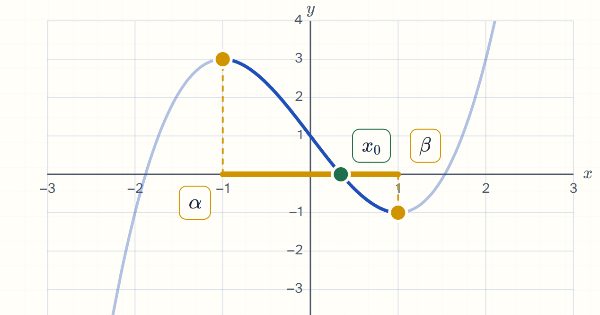 Bolzano’s theoremDrag the endpoints α and β and see when Bolzano’s theorem guarantees a root — and why a jump breaks it. Bisection then closes in on the root, step by step.
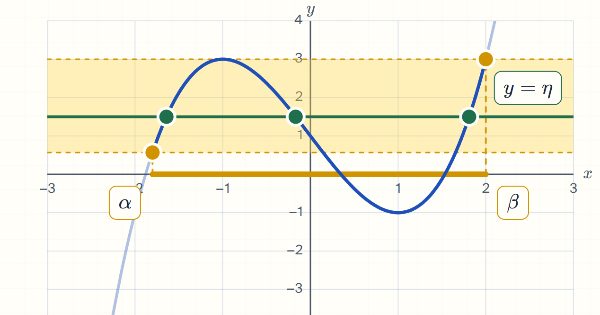 Intermediate value theoremMove the line y = η through the band between f(α) and f(β) and see every value reached — and which values a jump discontinuity skips over.
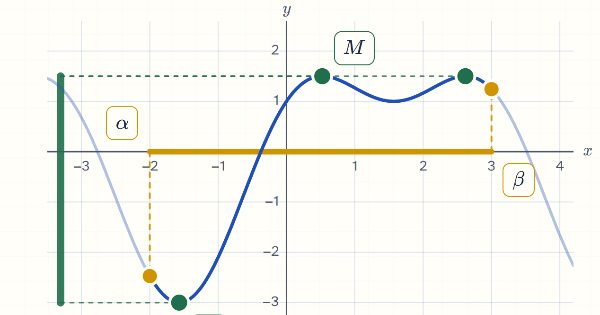 Extreme value theoremSee a continuous function reach its maximum and minimum on a closed interval, then open the interval and watch the extreme values disappear at the ends.
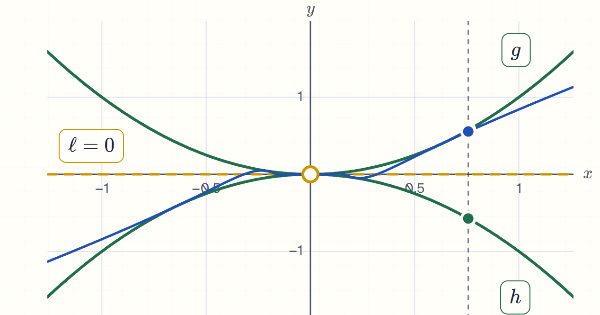 Squeeze theoremZoom in on x² sin(1/x), x sin(1/x) and sin x / x and watch two simple bounds squeeze each one to its limit. The squeeze theorem, made visible.
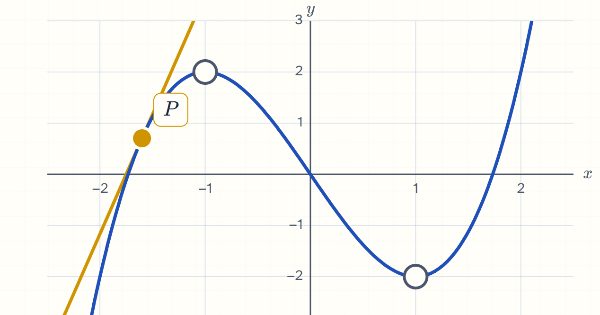 Fermat’s theorem on stationary pointsDrag P along the curve: at every interior maximum or minimum the tangent is horizontal. Then find a horizontal tangent that is not an extremum, and a corner.
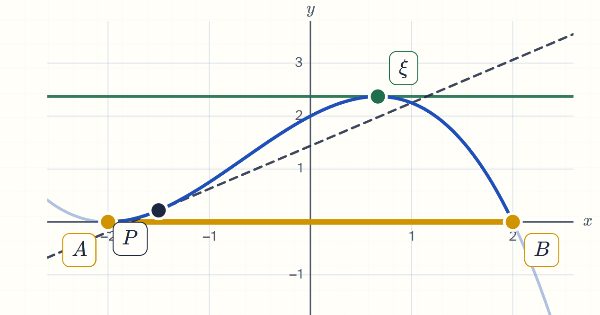 Rolle’s theoremDrag P until the tangent is horizontal: equal end heights, continuity and differentiability guarantee it. See what a single corner does to Rolle’s theorem.
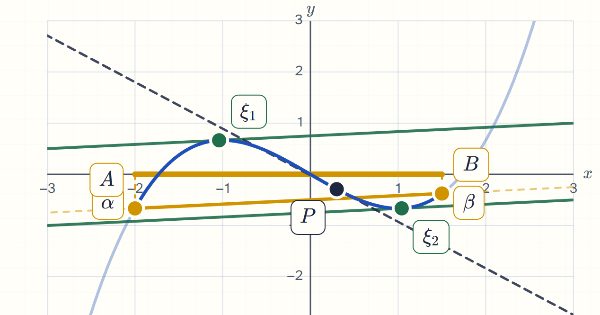 Mean value theoremDrag P until its tangent is parallel to the chord AB: the instantaneous rate of change meets the average. See why √x still works and |x| does not.
Calculus
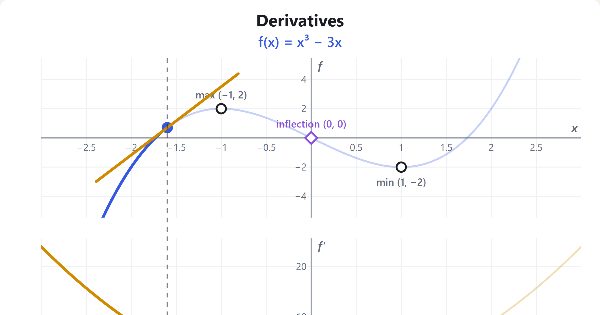 Derivative graphsDrag a point along any curve and watch its tangent trace the graph of f′, with f″, turning points, inflections, tangents and normals worked out.
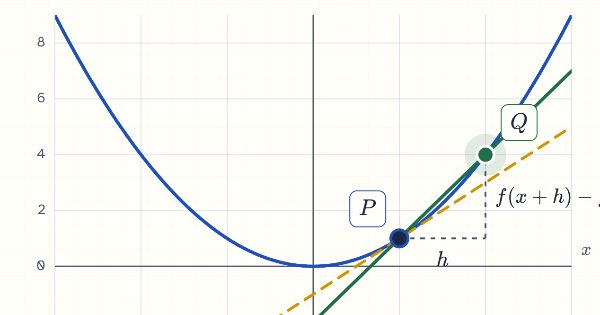 Differentiation from first principlesDrag P and Q on a curve and shrink h to watch the secant become the tangent, with the limit worked out step by step for x², x³ − 3x and sin x.
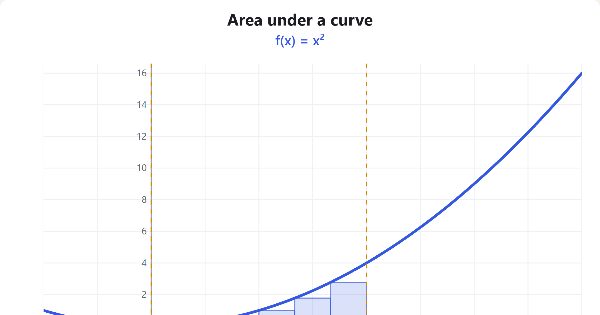 Area under a curveType any function, drag the limits a and b, and compare left, right, midpoint and trapezium estimates with the exact integral and the true area.
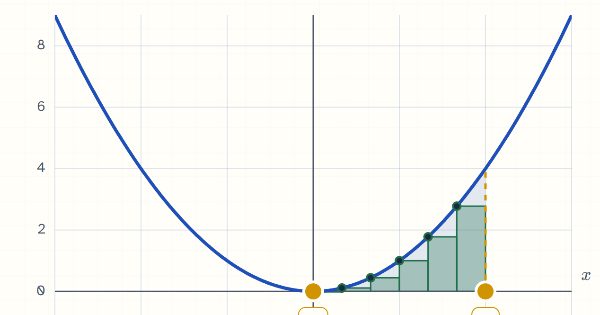 Riemann sumsSplit [a, b] into up to 100 rectangles, choose left, right or midpoint sample points, and watch the sum close in on the definite integral as n grows.
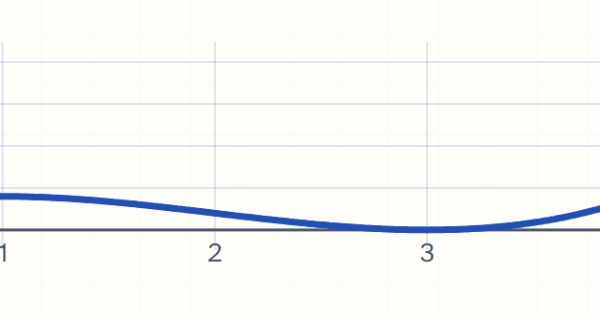 Kinematics graphsMove a particle along a straight line and watch its displacement, velocity and acceleration graphs update together, with distance set against displacement.
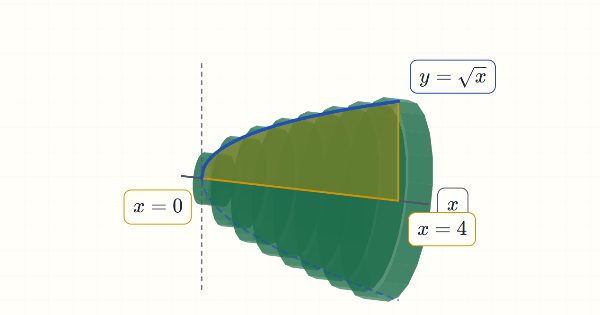 Volumes of revolutionRotate a region about the x- or y-axis, turn the solid in 3D, and compare the exact volume π∫y² dx with the total of up to 50 discs.
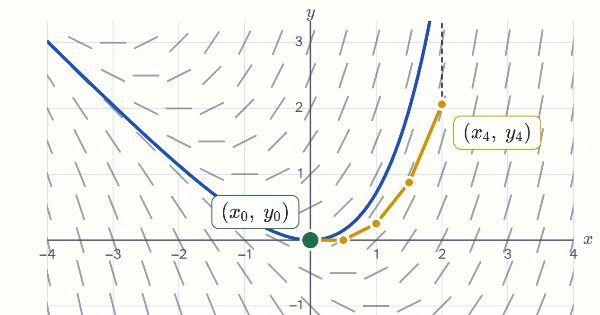 Slope fields and Euler's methodSee the slope field of a differential equation, drag the starting point, step along it with Euler's method and compare the result with the exact solution.
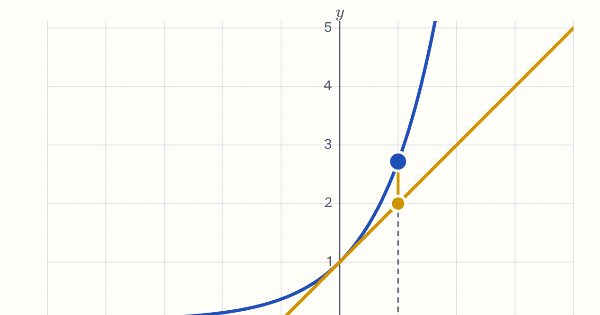 Maclaurin seriesCompare e^x, sin x, cos x, ln(1+x) and arctan x with their Maclaurin polynomials up to degree 15, and see where each approximation holds or fails.
Functions, sequences and algebra
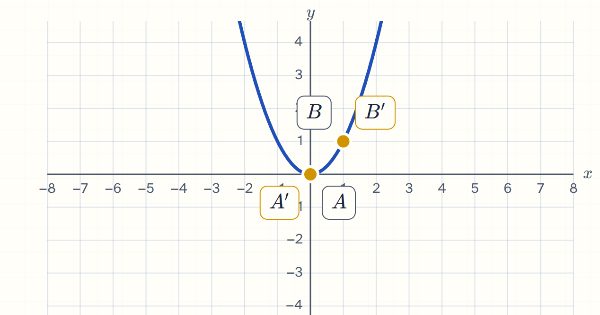 Transformations of graphsStretch, reflect and translate x², x³, sin x, eˣ and √x with sliders for a, b, c and d, and see exactly where each key point of the graph moves.
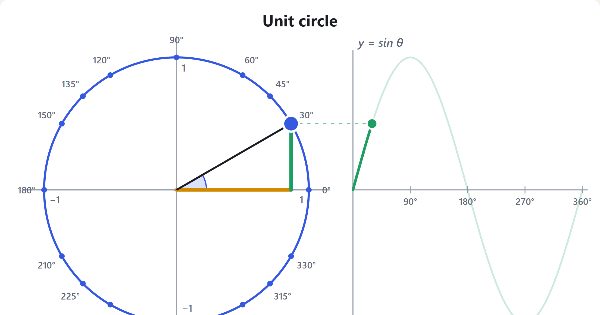 The unit circleDrag a point round the unit circle and see sin θ and cos θ as its coordinates, traced onto their graphs, with exact values in degrees or radians.
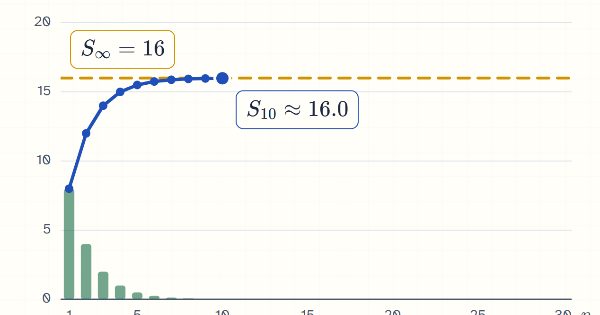 Geometric series and the sum to infinitySet the first term and common ratio of a geometric series and watch the partial sums approach the sum to infinity, or diverge when |r| ≥ 1.
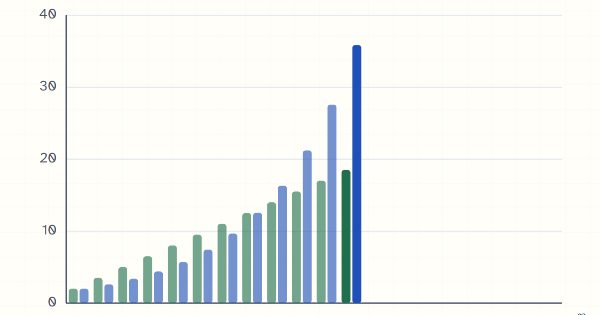 Arithmetic and geometric sequences, and compound interestCompare arithmetic and geometric sequences term by term, then see how compounding interest more often approaches the continuous limit.
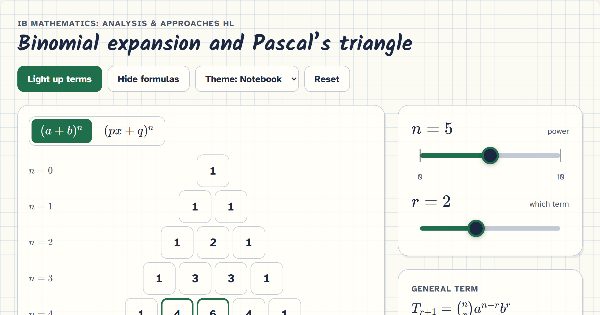 Binomial expansion and Pascal’s triangleSee how each row of Pascal’s triangle gives the coefficients of (a+b)ⁿ, and work out any term of (px+q)ⁿ with the binomial theorem.
Complex numbers and 3D
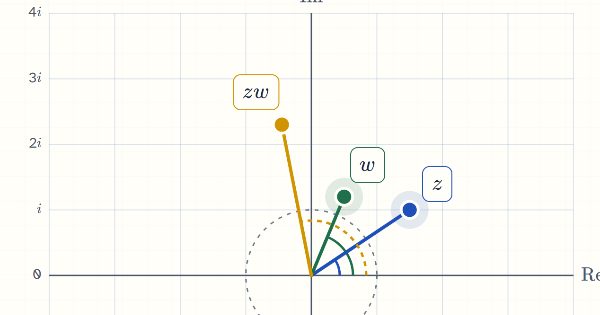 Complex numbers on the Argand diagramDrag two complex numbers and watch their product as moduli multiply and arguments add, then see the nth roots of unity form a regular polygon.
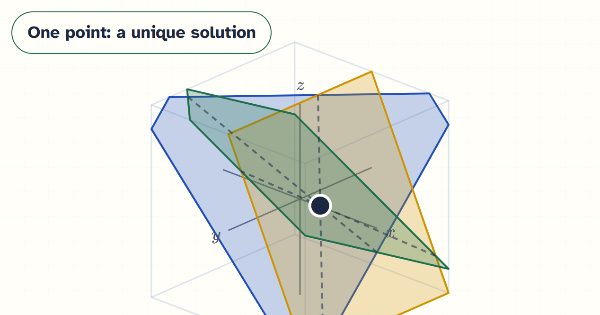 Intersection of three planesRotate three planes in 3D and change one equation to see when a 3×3 system has one solution, infinitely many or none, with the row reduction shown.
Cambridge IGCSE
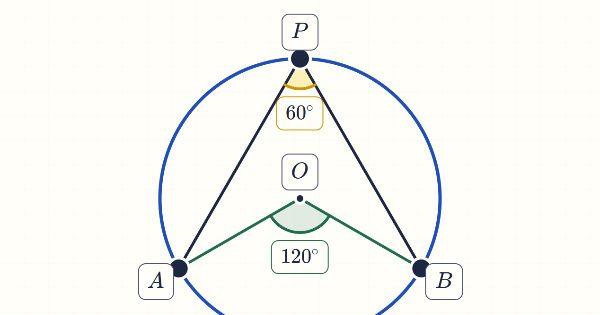 Circle theoremsDrag the points round the circle and watch all eight IGCSE circle theorems hold — angle at the centre, semicircle, cyclic quadrilateral, tangents, chord.
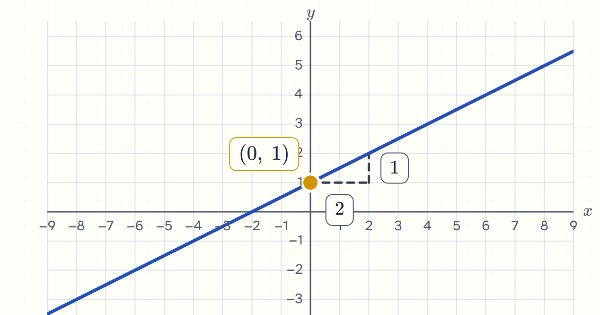 The straight line y = mx + cChange m and c, drag the gradient triangle, and see the parallel and perpendicular lines through any point, each with its equation worked out step by step.
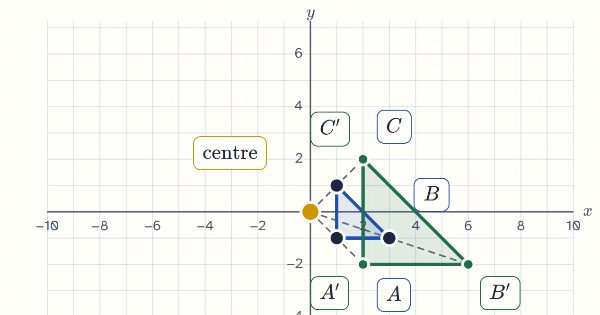 EnlargementDrag the centre and the shape, set a scale factor from −3 to 3, and watch the image appear along the rays from the centre, every image point worked out.
Teaching with these?
In Owlileo every visualiser goes on the lesson board with one tap, and the student sees every move live — alongside homework marked from a photo, tests that mark themselves and a question bank for your syllabus.
Start free →